
County Clerk vs. Recorder vs. Assessor: Who Holds Which Records?
County and state offices go by different names in different states. This guide explains what each office does so you can find the right one for the record you need.

Key takeaways
- Clerk, recorder, assessor, and treasurer each keep different records.
- Office titles vary by state, so search by the record you need.
- Not every county offers full online access.
A common reason people get stuck searching public records is simple: they contact the wrong office. County government is organized differently in every state, and the same job can have a different title depending on where you are. This guide explains the typical role of each office and how to work out who holds the record you want.
The Main Offices
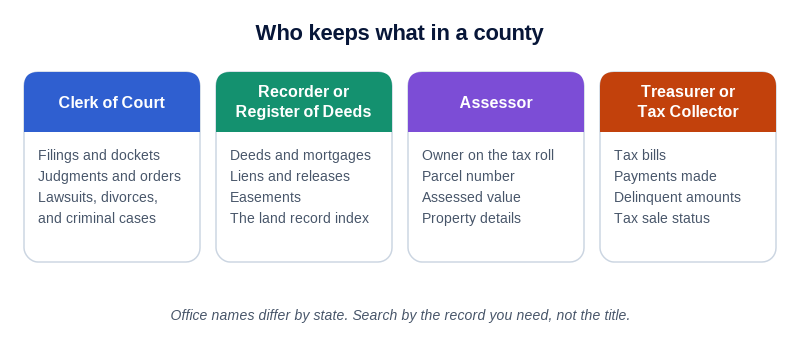
- Clerk of Court: keeps court case files, including filings, dockets, judgments, and sometimes marriage or probate records. Depending on the state, the clerk may be called the Clerk of the Circuit Court, Superior Court, or District Court.
- County Clerk: a role that varies widely. It may handle county board minutes, elections, and marriage licenses, and in some states the clerk also records property documents.
- Recorder, Register of Deeds, or County Recorder: records deeds, mortgages, liens, easements, and similar land documents, and keeps the index used to search them. In some places this function is combined, such as a County Clerk-Recorder.
- Assessor: determines the value of property for taxation and keeps property characteristics, ownership on the tax roll, and assessed values.
- Treasurer or Tax Collector: bills and collects property taxes and shows what is owed or delinquent.
- Sheriff: may publish jail rosters, civil process information, and, in some counties, arrest or warrant details.
State-Level Offices You May Also Need
- Secretary of State: usually keeps business entity filings, UCC filings, and sometimes notary and trademark records.
- State health department or vital records office: issues birth, death, and marriage certificates, often with restrictions on who can request them.
- State corrections department: maintains inmate locators for people in state prison.
- Professional licensing boards: verify licenses and show discipline for contractors, nurses, attorneys, and others.
Quick Guide: What You Want and Where to Look
- A lawsuit or divorce case: the Clerk of Court in the county where it was filed, or PACER for federal cases.
- Who owns a house and what it is worth for tax purposes: the Assessor.
- A deed, mortgage, or lien: the Recorder or Register of Deeds.
- Whether property taxes are paid: the Treasurer or Tax Collector.
- Whether an LLC is active: the Secretary of State in the state of formation.
- Someone in county jail: the Sheriff or county jail roster.
Why Titles Differ
States set up county government under their own laws. In one state the Clerk of the Circuit Court handles both court files and the official land records. In another, a separate Register of Deeds handles land and a Clerk of Superior Court handles cases. A few counties are consolidated with a city, which can change who handles what. That is why searching for the exact record, rather than the office title, is more reliable.

How to Find the Right Office Fast
- Start with the county website's department list and look for the office that matches your record type.
- If you cannot tell, use the search box with the record you want, for example "deed search" or "marriage license."
- Call the main county line and ask who handles the record. Clerks answer this question all the time.
- Use official state directories linked from our site to locate the correct county portal.
Online Access Is Not Uniform
Some counties offer detailed online search, while others only provide an index or require an in-person visit. Older records may be on microfilm. Some offices charge fees for copies or require an account. When an online search finds nothing, that does not always mean the record does not exist. It may only mean it has not been digitized.
Example: Researching a House Before You Buy
- Assessor: confirm the owner on the tax roll, parcel number, lot size, and assessed value.
- Recorder or Register of Deeds: review the deed history and look for mortgages, easements, and liens.
- Treasurer or Tax Collector: check that property taxes are paid.
- Clerk of Court: search for lawsuits, foreclosures, or judgments involving the owner.
- Local building or permit office: check permits and any open code violations.
Frequently Asked Questions
Why can't I find my county's recorder? The office may be part of the clerk's office, the county auditor, or another department. Search the county website for "deeds" or "land records."
Do all counties offer online search? No. Larger counties often do, while small counties may offer only an index or in-person access.
Official Sources and Further Reading
Fees and procedures change, so confirm details with the office that holds the record.
Written by
RecordWatchdog Team
RecordWatchdog is an independent publication about public records. It is not a law firm or a consumer reporting agency.
Published November 2, 2026
General information, not legal advice. Spotted an error? Tell us.