
How to Request Certified Copies of Public Records
When a plain printout is not enough, you need a certified copy. Learn what certification means, how to order, what it costs, and how to avoid delays.

Key takeaways
- A certified copy is an official copy that the custodian vouches for.
- Request it from the office that holds the original, and ask what kind of certification the receiving agency needs.
- Expect per-page and certification fees, and an apostille if the document is used abroad.
Looking up a record online is often enough for research. But banks, courts, immigration offices, and other agencies frequently require a certified copy, which is an official copy that the custodian vouches for. This guide explains what certification means and a step-by-step way to request one.
What "Certified" Means
A certified copy is a copy of a record that the office holding the original has stamped, sealed, or signed to confirm it is a true copy. A plain copy or a web printout does not carry that confirmation. Related terms you may see include:
- Certified copy: a true copy of an existing record, such as a deed, court order, or business filing.
- Exemplified copy: a court record certified with additional authentication, sometimes required when using a court record in another state.
- Certificate of good standing or existence: a document from the Secretary of State confirming that a business is active.
- Apostille: an additional certificate that authenticates a public document for use in another country that participates in the Hague Apostille Convention.
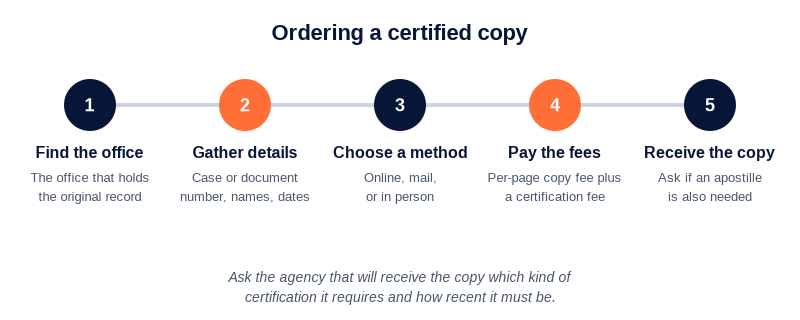
Step 1: Identify the Custodian
Request the record from the office that created or keeps the original. A court judgment comes from the clerk of the court that issued it, a deed from the county recorder, and a business filing from the Secretary of State. Birth and death certificates come from vital records offices. Our guide to county offices explains who handles what.
Step 2: Gather Identifiers
The more precisely you identify the record, the faster it will be found. Useful details include the full names involved, the case number, document number or book and page, the date of recording or filing, and the entity name. Locate these through the office's online search first.
Step 3: Check the Ordering Method
Many offices accept online orders, mail requests, or in-person requests. The office website usually lists the form, accepted payment, and mailing address. For restricted records, such as vital records, only certain people can order, and you may need to provide identification and proof of your relationship to the person on the record.
Step 4: Make the Request
If there is no form, a written request should include your name and contact details, a description of the record with identifiers, the number of copies, and that you want them certified. If the document will be used abroad, say so and ask whether an apostille is needed.

Fees and Timing
- Offices typically charge a per-page copy fee plus a separate certification fee. Amounts vary by state and office.
- Online orders and in-person requests are often faster than mail. Processing may take from same-day to several weeks.
- Expedited service sometimes costs extra.
- Confirm the current fee and accepted payment methods before sending money.
Public Records Requests vs. Certified Copy Orders
Requesting certified copies of ordinary court, land, or business records is usually a routine service. A public records request, such as under FOIA or a state public records act, is a different process used to obtain agency documents that are not already available through a routine service. Use the process that matches what you need.
Avoiding Delays
- Verify the record exists and note the exact identifiers before you order.
- Ask the receiving party, such as a bank or agency, exactly which kind of certification they accept and how recent it must be.
- Include a self-addressed stamped envelope for mail requests if the office asks for one.
- Allow extra time if an apostille is also needed, since it is a separate step.
- Sealed, expunged, or confidential records may not be available to the public, even with certification.
Sample Request Letter
If the office has no form, a short letter or email like this works:
To the Clerk of Court: Please provide one certified copy of the final judgment in Case No. [number], [Party A] v. [Party B], filed on [date]. I am enclosing payment for the copy and certification fees (or please let me know the total). Please send the copy to the address below. Contact: [name, address, phone, email].
Frequently Asked Questions
How recent does a certified copy need to be? It depends on who is asking. Some banks and agencies require certification within a set number of days or months, so ask them.
Can anyone order a certified copy? For ordinary court, land, and business records, usually yes. Vital records and sealed or confidential records are restricted.
What if the office cannot find the record? Ask them to confirm the search criteria used, double-check the case or document number, and consider whether the record is held by another office or an archive.
Official Sources and Further Reading
- USAGov: local government directory (usa.gov)
- USAGov: state government directory (usa.gov)
- Hague Conference: Apostille Convention (hcch.net)
Fees and procedures change, so confirm details with the office that holds the record.
Written by
RecordWatchdog Team
RecordWatchdog is an independent publication about public records. It is not a law firm or a consumer reporting agency.
Published November 2, 2026
General information, not legal advice. Spotted an error? Tell us.